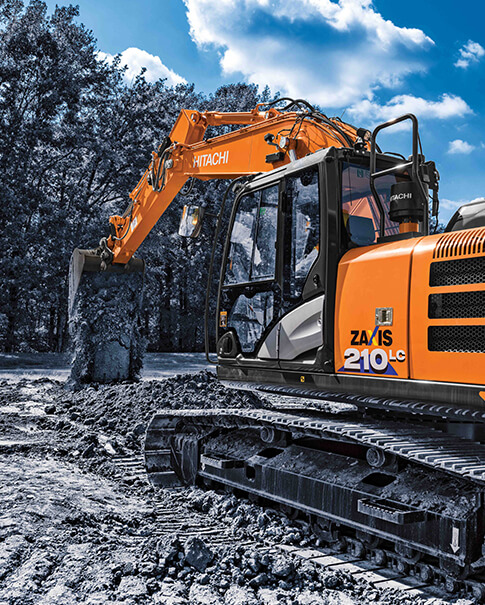
Distributors entering Latin America often import a stock profile designed for a market where machines are newer, dealer coverage is dense and overnight parts delivery is normal. None of those conditions hold across most of the region. Fleets run longer, owners repair rather than replace, and the nearest dealer may be a flight away. The inventory that works is the one that keeps a working machine working this week.
| Market condition | Effect on your stock |
|---|---|
| Machines kept in service for 15,000+ hours | Undercarriage, hydraulic pumps and final drives move faster than on a young fleet |
| Repair shops, not only fleet owners | Small quantities across many numbers; seal kits and gasket sets become core stock |
| Long inland distances | Customers buy two weeks ahead; your fill rate matters more than your price |
| Import clearance variability | Keep a buffer on numbers you cannot afford to be out of, and document everything |
Before ordering anything, list every excavator you can physically reach within a day's drive: model, serial prefix, year, owner type. Twenty phone calls to workshops and rental yards will give you a more accurate demand picture than any market report. What you are looking for is concentration — the two or three model families that appear again and again.
Across the region the pattern usually includes Komatsu PC200 and PC300 classes, Hitachi ZX200 and ZX330, CAT 320 and 336, and a strong secondary population of Hyundai and Volvo. Brazil and Argentina add locally assembled or imported Doosan and Case units. Your list will differ by city, which is the point.
Consumables pay the rent. They are cheap to ship, turn over quickly and let a customer test you with a small order. For each dominant model, cover:
These are the lines where a missing item is annoying but a missing set is fatal. If a workshop asks for a cylinder seal kit and you have three of the four parts, you have not made a sale.
Pumps and final drives carry the margin but also the risk. Stock them only where you can test and service them. A main hydraulic pump on the shelf without a test bench is a bet, not an asset. The same applies to a travel gearbox: if you cannot check oil condition and rotating resistance before delivery, you cannot defend a warranty claim.
A practical rule: one assembly per 25 machines in your catchment area, and only for the model family you see most. Two units of the right pump outsell six units of the wrong one.
Not every part deserves the same depth. Sorting by consequence rather than by price keeps capital working.
| Tier | What belongs here | Depth |
|---|---|---|
| A — machine stoppers | Filters, sensors, fan belts, hose assemblies, seal kits | Three to six months of measured demand |
| B — scheduled repairs | Undercarriage components, cylinder parts, turbochargers | One to two sets per dominant model |
| C — planned overhauls | Pumps, final drives, injectors, cylinder heads | One unit, ordered against a named customer |
| D — long tail | Rare numbers, obsolete castings, one-off electrical items | Zero. Quote on request. |
Latin America is not one operating environment, and the differences show up in parts demand.
The import side decides whether your inventory plan survives contact with reality. Three practical points:
Trade events are a useful shortcut to the right forwarder and the right customers in one week — the M&T Expo in Brazil is where much of the regional supply chain meets.
Workshops buy time. A 500-hour service kit assembled in one box — filters, seals, belts, washers — sells faster than the same items priced individually, and it protects your margin because the customer stops comparing line by line. Build three kits for your dominant models: a service kit, a cylinder reseal kit, and an undercarriage refresh kit.
OTTO supplies engine parts, hydraulic pumps, final drives and undercarriage components for the Japanese, Korean and Chinese machine families common in Latin America. Part numbers are confirmed against the machine model and serial before packing, and each shipment carries an invoice and packing list that match the cartons line by line.
Spanish-language catalogue access is available through the Spanish site. Warranty is honoured by OTTO against the original invoice; the specific terms for your order are those printed on the quotation, not a general statement.
To build a stock proposal, send your machine list and the models you see most. We will return a suggested first order split into consumable, scheduled-repair and assembly tiers, with weights and volumes so you can see what fits a pallet and what needs a container. Reach us through the contact page.
Send your machine population and we will map a stock profile against it — consumables first, assemblies only where you can service them.
Chat on WhatsAppEnough to cover the consumable floor for two or three model families, and no more. Many distributors start with a pallet or a shared container and reinvest the first cycle's cash. The number matters less than whether every line has a named customer or a repeat workshop behind it.
Whichever is more common within your delivery radius. Count the machines. In most Andean and Southern Cone markets both appear, but one usually dominates the rental and repair segment, and that is the one that turns stock into cash.
You need to be able to supply them, not necessarily hold them. A credible distributor quotes an assembly with a firm lead time and a test report. Holding one unit of the right model helps; holding six of the wrong model does not.
Agree the process before the first order: who inspects the failed part, what evidence is required, and whether credit or replacement applies. Photographs and a written failure description resolve most claims. A supplier who will not put the process in writing is telling you something.
One container lowers unit freight but locks capital in a single bet. Several pallets cost more per cubic metre but let you correct the mix after the first cycle. For a new market, the second option is usually the cheaper education.
Tel : +86-15302269990
WhatsApp : +8615302269990
WhatsApp : +8619125112809
E-mail : service@gzotto.com
E-mail : sales02@gzotto.com
Address : No.1108 & 1109 Tower 2, Yuzhu haisi innovation Center, Huangpu District, Guangzhou, China
Friendly Links :
hitachi-isuzu© 2026 OTTO EXCAVATOR PARTS CO., LIMITED All Rights Reserved.

Hi! Click one of our members below to chat on


