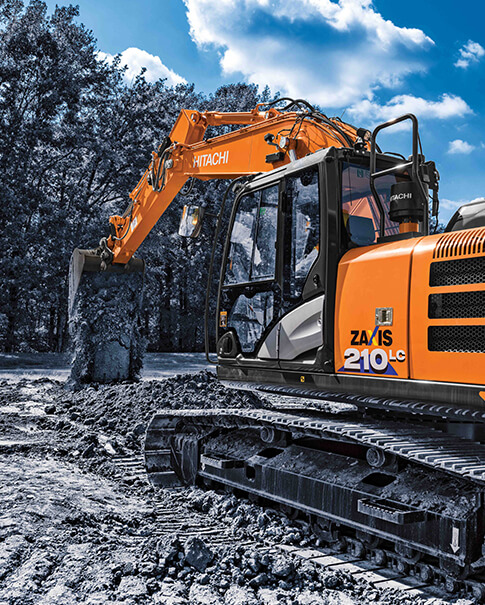
In high-tonnage mining and quarrying operations, production metrics are tracked down to the minute. Every bench, haul road, and crushing circuit is engineered for continuous throughput. At the center of this production chain sits the primary loading excavator—a 45-ton to 90-ton crawler excavator digging blasted ore and loading 40-to-60 ton off-highway haul trucks.
When this primary excavator unexpectedly trips out or suffers a catastrophic hydraulic seizure, the financial hemorrhage is instantaneous. Yet, procurement departments often evaluate spare parts solely by their unit purchase price, ignoring the massive downstream financial risks of component failure. Drawing on decades of heavy machinery parts supply to international mining enterprises, OTTO Heavy Equipment Parts breaks down the true economics of excavator downtime and proves why quality-certified components are the most profitable investment a mining operation can make.
Most maintenance budgets only account for direct repair expenses: the cost of the replacement pump and the technician's hourly labor. However, real-world mining downtime comprises four cascading financial layers:
| Cost Category | Mining Operational Impact | Typical Hourly Impact (70t Fleet) | Share of Total Downtime Cost |
|---|---|---|---|
| Lost Production Output | Unmined ore, missed daily shipping quotas, reduced mill feed volume. | $3,500 - $8,000 / hour | 65% |
| Haul Fleet Underutilization | 4 to 6 assigned haul trucks idling or re-routed, burning standby fuel. | $800 - $1,800 / hour | 18% |
| Secondary Component Damage | Metal debris from failed pump circulating into main control valves and cylinders. | $5,000 - $25,000 lump sum | 10% |
| Emergency Logistics & Labor | Emergency air charters, overtime mechanics, hot-shot road transport. | $2,000 - $6,000 lump sum | 7% |
When evaluated comprehensively, a 24-hour breakdown on a primary production excavator costs a mining company between $85,000 and $220,000. In this context, choosing a low-grade replacement part simply to save $1,200 on an initial invoice is an extraordinary operational gamble.
The global machinery market is flooded with low-cost aftermarket parts produced by unvetted workshops that cut corners on metallurgy, heat treatment, and precision tolerances. While these parts look superficially acceptable in a photograph, their failure mechanisms under severe mining duty are well-documented:
In high-pressure axial piston pumps operating at 35 MPa, cylinder blocks and valve plates must maintain surface flatness within 0.001 mm. Low-cost manufacturers use commercial ductile iron rather than bimetallic high-tin lead bronze castings. Under high continuous hydraulic oil temperatures (75°C to 85°C), the bronze layer delaminates, disintegrating inside the pump casing in under 500 operating hours.
Planetary gears in final drives must endure extreme cyclic torsional shock when an excavator negotiates uneven, blasted granite benches. Certified OEM gears undergo controlled induction carburizing to achieve a surface hardness of 58-62 HRC with a ductile core. Budget aftermarket gears feature shallow case depths (under 0.8 mm); the hardened surface fractures under shock load, causing catastrophic tooth shearing and complete gearbox lockup.
When an inferior pump or motor disintegrates catastrophically, it does not die cleanly. Tens of thousands of microscopic metal shavings are pumped directly into the machine's closed hydraulic circuit, contaminating the main control valve, pilot manifolds, and hydraulic cylinders. Flushing this contamination requires over 40 technician hours and thousands of dollars in fresh hydraulic oil and filters.
To demonstrate the quantifiable return on investment from quality parts, consider a 50-ton mining excavator requiring a main hydraulic pump replacement over a 24-month operating cycle (8,000 operating hours):
| Financial Parameter | Budget Aftermarket Pump | OTTO Certified OEM-Grade Pump |
|---|---|---|
| Initial Component Purchase Cost | $4,200 | $6,800 (+$2,600 initial variance) |
| Expected Component Operating Life | 1,800 Hours (Requires 4 units over cycle) | 8,000+ Hours (1 unit covers entire cycle) |
| Total Component Acquisition Expense | $16,800 ($4,200 x 4) | $6,800 |
| Unscheduled Failure Downtime Loss | 3 Premature Failures = 72h Downtime ($252,000) | 0 Premature Failures (Planned changeout only) |
| System Flushing & Secondary Repairs | $18,000 (Flushing, filters, oil replacement) | $0 |
| Total 2-Year Operational Cost | $286,800 | $6,800 (Net Savings: $280,000) |
Investing in certified quality up front saves over $280,000 in total lifecycle costs—delivering an unmistakable return on investment for mining operations.
At OTTO, we treat every mining component as mission-critical equipment. Every assembly leaving our Guangzhou facility is backed by a strict four-stage quality verification process:
Demand three items: (1) Dyno test reports detailing flow, relief pressure, and case drain flow at operating temperature; (2) Detailed photos of raw casting marks and identification plates; and (3) Written warranty documentation guaranteeing minimum operating hour benchmarks.
Yes. We maintain active production lines and inventory for legacy mining machines, including Komatsu PC400-6/7, Hitachi ZX450-3/ZX870-3, and Caterpillar 345C/349D series, ensuring reliable long-term parts availability.
Key warning signs include elevated case drain flow (above 30 L/min), rising hydraulic oil operating temperatures (exceeding 85°C), unusual high-pitch whining under load, and visible bronze glitter in the hydraulic return filter.
While no part lasts forever in severe mining environments, certified components provide predictable wear curves, allowing maintenance teams to schedule planned changeouts during scheduled maintenance windows rather than suffering unexpected pit-face shutdowns.
We maintain pre-booked air freight cargo allocations from Guangzhou Baiyun Airport (CAN) and Hong Kong (HKG), backed by pre-cleared customs documentation, enabling 24 to 72-hour air transit to major global mining hubs.
In high-tonnage mining, uptime is everything. Cutting corners on component quality is the most expensive mistake a procurement manager can make. Partner with OTTO to secure factory-certified components, transparent engineering documentation, and reliable global delivery.
Contact our mining technical sales engineers for component pricing, dyno test documentation, and volume supply agreements.
WhatsApp Us: +86 153 0226 9990 Request Quality Assurance QuoteTel : +86-15302269990
WhatsApp : +8615302269990
WhatsApp : +8619125112809
E-mail : service@gzotto.com
E-mail : sales02@gzotto.com
Address : No.1108 & 1109 Tower 2, Yuzhu haisi innovation Center, Huangpu District, Guangzhou, China
Friendly Links :
hitachi-isuzu© 2026 OTTO EXCAVATOR PARTS CO., LIMITED All Rights Reserved.

Hi! Click one of our members below to chat on


